NATARAJA GURU 1895–1973
Nataraja Guru was born on 18th February 1895 in Bengaluru as the second son of Dr. P. Padmanabhan, popularly known as Dr. Palpu, and Mrs. Bhagavathi. Even though Dr. Palpu graduated at the top of the class to become highly qualified as a physician, due to extreme practices of casteism in his home-state of Kerala, he had to seek employment in the neighbouring state of Mysuru where he was court physician of the king of Mysuru state and headed the state department of health.
Dr. Palpu’s work in different parts of the state resulted in young Nataraja shuttling throughout his school-going years between Bengaluru and Trivandrum, the paternal home city in Kerala. He also attended Trinity College in Kandy, Ceylon. During his adolescent years he was attracted to Mahatma Gandhi’s non-violent resistance to gain India’s freedom from the British, Rabindranath Tagore’s poetry, and Swami Vivekananda’s teachings. In 1915 young Natarajan officially completed his matriculation and then joined Presidency College at Madras. After more than six years of study he finished his university studies with a first rank master’s degree in zoology and geology and passed the licentiate in teaching (L.T) from Teachers College at Saidapet, Madras.
In the early days of 1899, when Natarajan was 4 years old, his parents took him to the riverside hermitage of Narayana Guru. This enigmatic figure sat under a tree surrounded by many devotees. Little Natarajan refused to prostrate in front of the Guru even though his parents prostrated and asked him to do the same. Guru Narayana smiled and quipped, “He knows he is a doctor’s son and doesn’t want to kowtow in front of anyone.” Later, the prospective sishya (disciple) and the Guru would often meet at Dr. Palpu’s residences, either in Bengaluru or in Trivandrum. This affiliation turned into total adoption of Narayana Guru as his preceptor soon after his college life.
Natarajan, who became Nataraja Guru, wanted to further Narayana Guru’s quest and to help in his mission. During his stay in the Aluva Advaita Ashram of the Guru the dream for an ideal educational institution came into his mind. However, underlying adverse currents in the ashram led Natarajan to relocate to the Nilgiris Hills of Tamilanadu. Prior to leaving Kerala, Natarajan went to the Guru with his plans of starting a Gurukula exemplifying the ancient tradition of a teacher and his disciples living under one roof and teaching and learning together. When he sought the Guru’s blessings, the Guru instructed Natarajan not to forbid marriage. The Guru also wrote an instructive poem explaining what an Ashram should be and the qualities of the head (Guru) of such an Ashram. With the Guru’s full sanction and approval, Natarajan left to work on the educational institution of his dream.
However, financial difficulties and smallpox brought an end to this first venture after less than a year. Still, Natarajan put some efforts to find a permanent home. On 8 June 1924, the foundation stone of a new building for Narayana Gurukula, was laid on the new site at Fernhill, near Ooty. He returned to the Varkala ashram of Narayana Guru, beginning a few years of benefitting from close association with Narayana Guru.
Still motivated by his dream to establish contemplative educational centers, with Narayana Guru’s blessing and financial support, he went to Europe to study in an atmosphere freer from casteism and hide-bound tradition. Natarajan joined the Sorbonne University in Paris, where he secured a Doctorate in Literature with triple honours on the topic “The Personal Factor in the Educative Process.” During the five years of studies, he also taught at the Quaker International School in Geneva and visited many parts of Europe, meeting with some of the philosophical and scientific luminaries of that time.
While in Geneva, Natarajan received the news of the Guru’s mahasamadhi (great absorption or merger) on 28 September 1928. At the conclusion of his studies and teaching in Europe, Dr. Natarajan returned to India in 1933. After unsuccessfully pursuing employment in education, he went back to Fernhill in the Nilgiris and re-started the Gurukula. Integrating ancient wisdom with modern scientific exactitude was taken up as his life's mission. He clearly enunciated a common epistemology of all life interests of people to liberate themselves from social complexities and live their natural value visions. In support of that mission, on his 50th birthday, Dr. Natarajan took five resolutions: to write a book about the Guru, to found a centre in the west for the teachings of Brahmavidya (The Science of the Absolute), to lecture in the States on One Religion, to complete still further his education, both Eastern and Western, and to study the programs of the United Nations and the UNESCO so as to be able to form ideas about world unity.
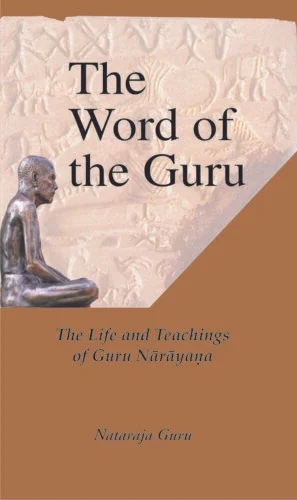
While taking these birthday resolutions, Dr. Natarajan hardly knew how they might come true. But Tao has its own mysterious ways of turning impossibilities into possibilities. He was invited to a World Conference of Religions to be held in New York in 1948, where he gave a speech titled “The World’s Religion for Peace,” an extension of Narayana Guru’s declaration of One Race, One Religion, and One Goal or God for Man. This was followed by months of travel in the US and Europe, rich with inner and outer adventures of conferences, study, and the fellowship of old and new friendships warmed by the absolutist element. During this time, he wrote his book about Narayana Guru, The Word of the Guru.
Upon his return to Varkala in 1951, Nataraja Guru was publicly recognized as the successor of Narayana Guru and as a Guru in his own right. In preparation of the centenary of Narayana Guru in the year 1954-55 and his own sixtieth birthday, he decided to start the annual Gurukula Convention and the Gurukulam magazine in Malayalam. Concurrently, through the dedication of Nataraja Guru’s disciple, John Spiers, the English magazine, Values, provided the means for publication, in serial form, of many Nataraja Guru’s major works.
On 1st January 1956, Nataraja Guru also registered a will and testament to further ensure the legal status of Narayana Gurukula, which was growing to include over twenty centres in south India. His several books in English and Malayalam represent a serious probe into the fundamentals of life so that the reader can simplify his or her own problems of domestic entanglements and clouded value vision. They are guides to gaining methodological efficiency in discovering the higher truth that can bring excellence in life. Most significant among them are his commentary on the Bhagavad Gita, Word of the Guru, One Hundred Verses of Self-Instruction, Autobiography of an Absolutist, his commentary on Saundarya Lahari, and his magnum opus based on Narayana Guru’s Darsanamala: An Integrated Science of the Absolute.