Word of the Guru
The Life and Teachings of Guru Narayana
by Nataraja Guru
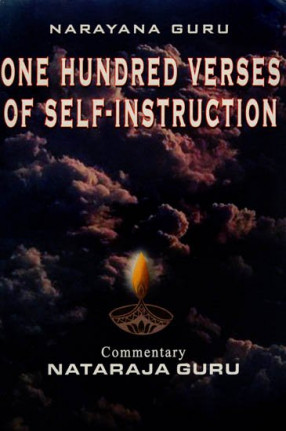
The one hundred verses of this book have their original in Malayalam verses from the pen of Narayana Guru himself. Narayana Guru’s earliest writings were clothed in a mythological language depending much on the gods or goddesses of what is sometimes called the Hindu pantheon including Siva, Vishnu, Subrahmanya or Kāli. Even in those, the case for Advaita Vedanta could be seen showing itself from behind, as it were, the thin superficial veneer of a conventional style evidently adopted by him for the purposes of the common devotee to whom he had necessarily to address himself in those temple-movement days. Later years gave a more positivist orientation to his writings and getting rid even of the esoterics implied in his Śiva-Satakam (One Hundred Verses to Siva).
Procedure to Buy Books
- Email or call with the list of books required.
- Receive availability & pricing details.
- Make payment through the provided bank details / UPI.
- Share your full postal address and contact number.
- Books will be dispatched and tracking details shared.
Books may also be collected in person from the Gurukula office.
About This Book
Overview
The one hundred verses of this book have their original in Malayalam verses from the pen of Narayana Guru himself. Narayana Guru’s earliest writings were clothed in a mythological language depending much on the gods or goddesses of what is sometimes called the Hindu pantheon including Siva, Vishnu, Subrahmanya or Kāli. Even in those, the case for Advaita Vedanta could be seen showing itself from behind, as it were, the thin superficial veneer of a conventional style evidently adopted by him for the purposes of the common devotee to whom he had necessarily to address himself in those temple-movement days. Later years gave a more positivist orientation to his writings and getting rid even of the esoterics implied in his Śiva-Satakam (One Hundred Verses to Siva).
We see him in this present work attaining to a philosophical context of Self-realisation rather than that of adoration of any deity, steering clear of local or traditional colorations. He approximates thus for the first time to the open and dynamic style of the Upanishads themselves where the teachings centre round the absolute value called Self or the Ātman and not any god to adore as hitherto. An open reference to the Upanishads could even be found in verse 14. This work of the Guru thus emerges early in his writing career fully echoing the spirit of the Upanishads, where the centre of interest of value moves, as it were, from an outside locus into the domain of the Absolute Self. The limitations of the understanding of the devotees to whom these verses had to cater, however, kept him within the limits of a religious scriptural form without gaining a fuller status as an open and critical philosophical work as revealed only later in such works as Brahmavidyā-Panċakam and the Darśana-Mālā, which are the more finalized fruits of his life of contemplation of the Absolute from all the three perspectives of cosmology, theology and psychology. Even the voice of obligation in which a certain course of behaviour, faith or understanding, whether ethical or religious, is not transcended here. It is in fact a confection in which the Upanishadic teaching is treated also as a way of life. Such a way of life has a fully open and dynamic character, instead of being closed or static as in hide-bound religion or ethics.
The reader could profitably read the essays by the present commentator, The Philosophy of a Guru* which enables him to enter in the further implications of this work which is meant to be both a scriptural composition recommending a way of life as well as the clarification of the highest problems of Advaita Vedanta itself.
It would be helpful for the reader also to remember that the cryptic language which comes to evidence in almost every natural group of verses, inevitably yields up their secret when subjected to a structural analysis which we have recommended many times elsewhere. Esoterics will become lit up to have a fully scientific status when subjected to such a schematic scrutiny. If the verses or the comments should still retain a certain strangeness from conventional norms, the excuse could be found perhaps in the attempt to lay the foundations of a type of literature fully emancipated from the possible prejudices and mental conditions belonging to limited spheres of time or clime. Conventions cannot be respected side by side with an open, scientific or universal outlook.
Meet the Author
