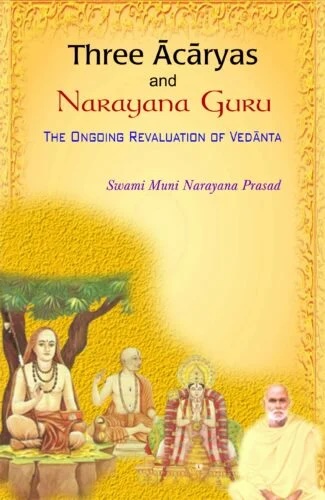
Three Acharyas and Narayana Guru
The Ongoing Revaluation of Vedanta
by Swami Muni Narayana Prasad
The book speaks about the philosophy of Narayana Guru as guidance to study and compare the philosophies of the acaryas, particularly those of Shankara, Ramanuja and Madhva. It also explores the concepts of avidya and maya, atomicity of the self, consciousness and the self, tat tvam asi, karma and reincarnation and the ultimate liberation.
Procedure to Buy Books
- Email or call with the list of books required.
- Receive availability & pricing details.
- Make payment through the provided bank details / UPI.
- Share your full postal address and contact number.
- Books will be dispatched and tracking details shared.
Books may also be collected in person from the Gurukula office.
About This Book
Overview
Shankara, Ramanuja and Madhva are considered the three acaryas of South India who commented on the three basic texts of Vedanta, that is, the Upanishads, the Brahma-Sutras and the Bhagavad-Gita, and therefrom originated the three major schools within the Vedanta fold — Advaita, Vishishtha advaita and Dvaita respectively. This volume is concerned with the philosophy of the famous saint-teacher Narayana Guru and his perspectives on the philosophies of the three acaryas.
The book uses the philosophy of Narayana Guru as the guide to study and compare the philosophies of the acaryas. It begins with the life sketches of the three acaryas and discusses their philosophies, especially the various specific viewpoints they maintained and the points on which they disagreed. It explores the ideas of the acaryas on avidya and maya, atomicity of the self, consciousness and the self, tat tvam asi, karma and reincarnation and the ultimate liberation. It also scrutinises their use of terms like that of atha which literally means now then. It examines the perception of Narayana Guru vis-a-vis the particular philosophical positions in a unified manner. It also contains the full text, transliteration and translation of the original Vedanta-Sutras of Narayana Guru.
The volume will interest students and scholars who are engaged in advanced studies on the philosophy of Vedanta, and persons keen on acquainting themselves with the philosophy of Narayana Guru.
Meet the Author